"Murray is the best kind of literary biographer" – The Financial Times.
For more information about the books of Nicholas Murray
click HERE and access his website
Winner of the 2015 Basil Bunting Award for poetry

Monday, 25 September 2023

New Poetry Collection

My new poetry pamphlet from Melos Press, The Dictionary Speaks, is now out and can be ordered post-free via this link.

From the publisher’s blurb:-

NICHOLAS MURRAY’S many books include poetry, two novels, critically acclaimed biographies of Franz Kafka, Aldous Huxley, Bruce Chatwin, Andrew Marvell, and Matthew Arnold, and studies of Liverpool, Bloomsbury, and British poets of the First World War. He is a Fellow of the Welsh Academy and, with his wife Sue, runs the prize- winning poetry imprint, Rack Press.

ELSEWHERE: Collected Poems of Nicholas Murray was published in 2022. His poems deal with love and art, humanity, politics, and the natural world in a body of work marked by both passion and fine craftsmanship. David Harsent wrote that Murray has ‘a sure hand, whether with hard-edged satire... or sense impressions that produce place and event so vividly.’

PRAISE FOR EARLIER COLLECTIONS OF POEMS:

Of earth, water, air and fire: ‘A real treat...an elemental menagerie in which the poet’s own delight through verbal magic becomes ours.’ Christopher Reid

The Museum of Truth: ‘A stunning collection.’ Martina Evans

City Lights: ‘The poems have an emotional intelligence, a wit, I really admire.’ Michèle Roberts


Monday, 15 May 2023

From a Loyal Subject

 Invective for an Imminent Investiture


Here is our gift to you, please take it, everyone needs a Prince,

and Wales should be grateful: never look a gift horse in the mouth

in spite of missing or yellowing teeth and various hints,

in the region of the back end of the nag, of trouble to come.


There are experts on hand with handbooks of courtly etiquette;

they are skilled in the manufacture of tradition, protocol,

they can sketch a crimson carpet unrolled over stone steps

for brocaded slippers to tread (slowly, magnificently).


They have studied form, know what The People love to see

in a gilded procession, trumpets blasted in a row

from a high turret (castles in such cases obligatory)

and everything that flags and clopping horses can do.


Roll out the barrel. Chips with everything. Party time!

A small girl speaks into a microphone: it was so emotional.

She is persuaded that the King and her grandad chime,

show the same wrinkles and baldy twinkles, smile


with the lovely ease of condescension at The Young

who are seen to look up from their mobiles and gawp,

briefly, before a Tweet comes in or an anthem is sung

whose words they fumble for, heads scratched in bafflement.


In a city street, tables are erected for iced cakes, and the TV,

like a holy icon, burbles all day long, watched or unwatched,

as the bunting in Butetown or Bangor flutters free

and crowds line the route waiting to touch the royal hand.


All it needs now is a senate of bards, druid-like, holding a lyre

(or is it a leek?) with their formal odes hymning the Prince,

their long faces gravid with obedience, the loyal leer,

hands folded in front, heads bowed, white garments rippling.


Here is a battlement, high and windswept, jackdaws in flight.

All it needs is a short leap through the bright air

down to the mortal rocks, the sea foaming white,

and freedom at last in a thousand smithereens.


[First published in Planet, Feb-April 2022]


Tuesday, 7 March 2023

What Happened to the Poetry?


The Guardian 2023 New Poetry Choices: 

A Found Poem


A bold debut collection

delving into Blackness,

trauma, sexuality and the divine;


poems of gender, transformation

and the body in a collection about

authenticity and conformity;


the personal is political in a collection

reckoning with resistance, freedom,

caste and the refugee crisis;


drawing on a Hong Kong childhood

a new collection exploring 

postcolonialism and queer identity.


The above was a little nothing I put up on Instagram on New Year’s Day, having read the Guardian selections of the poetry assumed to matter among 2023’s prospective new titles. 

“So many people would not be amused,” was one response, to which I replied: 

“Well, yes, there’s nothing to be done with the humourless but my serious point here is that these poets have been let down by The Guardian which concentrates exclusively on their (wholly worthy) political messages and refuses to say anything about the poetry. The poem, Wallace Stevens said, is “the cry of its occasion”, its poetic form not its paraphrasable content. I speak as someone who has published a lot of political poetry!”

This argument is a very old one that invariably has us quoting Auden yet again: “Poetry makes nothing happen.” Others would go further and say that it isn’t the business of poetry to make things happen, it should simply be. Others still would favour political poetry that is studiously ambivalent like Marvell’s great Horatian Ode. Because of course we don’t want rants or propagandist tripe. Enough great political poetry has been written, however, for it not to need defenders. But currently there is a sense, sharpened by the strident “virtue-signalling” of the social media, that without visible adherence to a range of identitarian political stances a poet will not prosper. I cannot say whether this is true or false – it might just be grumpy prejudice from those who reject the politics or feel their poetry is being pushed into second place – but at least at the level of the noise made by publicity the argument feels persuasive.

At the end of last year I received two email comments from friends who are each poets and professors of English. Here is what they said in response to my own views on the poetry scene:

(a)

“I perfectly understand your feelings regarding the current poetry scene and the reviewing culture. My friend X recently said that the 'establishment' is now entirely driven by the politics of representation, so that 'poetry as such' is no longer their concern either. There was always plenty of virtue-signalling in the poetry world, and it hasn't got any better in the current climate.

My own view of poetry publishing now is that it needs to be done on something very like the eighteenth-century subscription model, where the books are produced strictly for the people that want them—not unlike print on demand. The problem, then, is that it's difficult to find new readers—so the internet locks us into our groups and we signal to each other without much access to any 'common' culture. But is there one, or was that always an illusion foisted by those who controlled the organs of opinion?”


(b)

“Interesting what you say about the poetry scene, which has clearly pulled itself out of shape. The prizes are a bit of a racket, decided, as you say, on extra-poetic principles, and no one publishes reviews any more. The main publishing houses (Faber, Picador etc) also seem to have lost their way, and can no longer lay claim to set any sort of standard-setting.”


Two poets hardly makes for a comprehensive, statistically sound, definitive judgement on the question but the fact is that I would have been surprised if anyone writing to me had not come to such conclusions. If there is anyone out there happy with the current state of poetry publishing and critical reception I would like to meet them.

Personally I would locate the difficulty in the reviewing culture – or its growing absence. I hardly seem to read any serious, discriminating reviews of new collections that are not social media style gush or that don’t sound like a series of blurbs stitched together into a group review. Many important collections simply don’t get reviewed at all with the result that the intelligent general reader, always hesitating before the challenge of contemporary poetry, is bereft of any reliable guide  – though the din of poets telling us on Twitter how “awesome” they are may be drowning such fine discrimination out. 

And it is not a question of identifying the winners and losers but of exploring what a good poem is, what its components might be, and whether the writing is satisfying. Formal questions, ways of saying, language and rhythm, image and music are all part of what makes a poem valuable (and what gives pleasure) and one wants poetry critics to focus on these things.

That doesn’t mean that “exploring postcolonialism and queer identity” is not legitimate in poetry. Far from it. No subject matter is alien to a poet.  But I am interested in the way it is done, the poetry that is made of this matter, and good criticism can help us to think about these vital questions. If a poem doesn’t foreground these dimensions it runs the risk of being an inferior form of agitprop and the poet would be better advised to paint words on a placard and get out on to the street to take what is likely to be more effective protest and direct action. 

Neither of my poet-professors cited above is a “reactionary” and neither, I hope, am I but we are worried about an abdication of critical responsibility. Truly politically engaged poets have as much to gain from reversing that as any aesthetic dilettante.

Could this be a New Year Resolution for poetry editors: start to commission reviews which focus on the poem and its medium, its expressive means, its formal qualities as much as, but not of course disregarding, its paraphrasable content?


Sunday, 8 January 2023

Three Wishes for 2023 in Poetry

  •  A little more humility. You are very good because you tell us so on Twitter but you are not “awesome”, “stellar” or “amazing”. Just concentrate on writing better and we will let you know how well you have done.
  •  A little more intelligent criticism. Serious reviewing of poetry seems to be in terminal decline. Many group reviews read like social media puffs or are written in a strange, over-egged language, like a demented blurb, in sentences that appear to have no discernible meaning. Many important new collections from small and large publishers get no reviews at all.
  • A little more reading. We have much to learn (not to mention enjoy) from the Illustrious Dead (and Living).

Wednesday, 5 October 2022

The Prime Minister Regrets by Nicholas Murray


The Prime Minister Regrets (October 2022)


That smoking gun, 
warm in my hand,
and the scarlet pool
on the tiled floor;

the white shirt spattered
and the mute stillness
of the cold corpse
might seem to some a proof

(now that you mention it)
of culpable wrong-doing.
But context is important here
and all is not what it seems.

I had no idea that the raised gun
and the pulled trigger
might result in such a scene.
Believe me, sincerely.

Do not rush to judgement,
or call me an arrogant oaf
whose lease is too long extended
who lies, easily, as others breathe

until the truth seems a word
light as an autumn leaf
that falls in a bright spiral
of papery flight, prettily.


Tuesday, 13 September 2022

Writing Material

Does it matter what one writes with? Creative writing tutors have their endearing prohibitions and recommendations (write about what you know, don’t use adjectives etc etc) but the physical medium of writing itself tends to be dismissed as nothing more than an irrelevant personal quirk that has little bearing on what gets written. 

But does it? Iris Murdoch famously preferred to write in fountain pen (“One should love one’s handwriting”) and the mystic union of hand and writing instrument (quill or MacBook) should not, perhaps, be too quickly dismissed. In a similar way, on a writer’s desk a pebble from a Greek beach, a statuette, a piece of coloured glass, can be the crucial co-ordinates of creativity, aids to the chancy manoeuvres of composition.

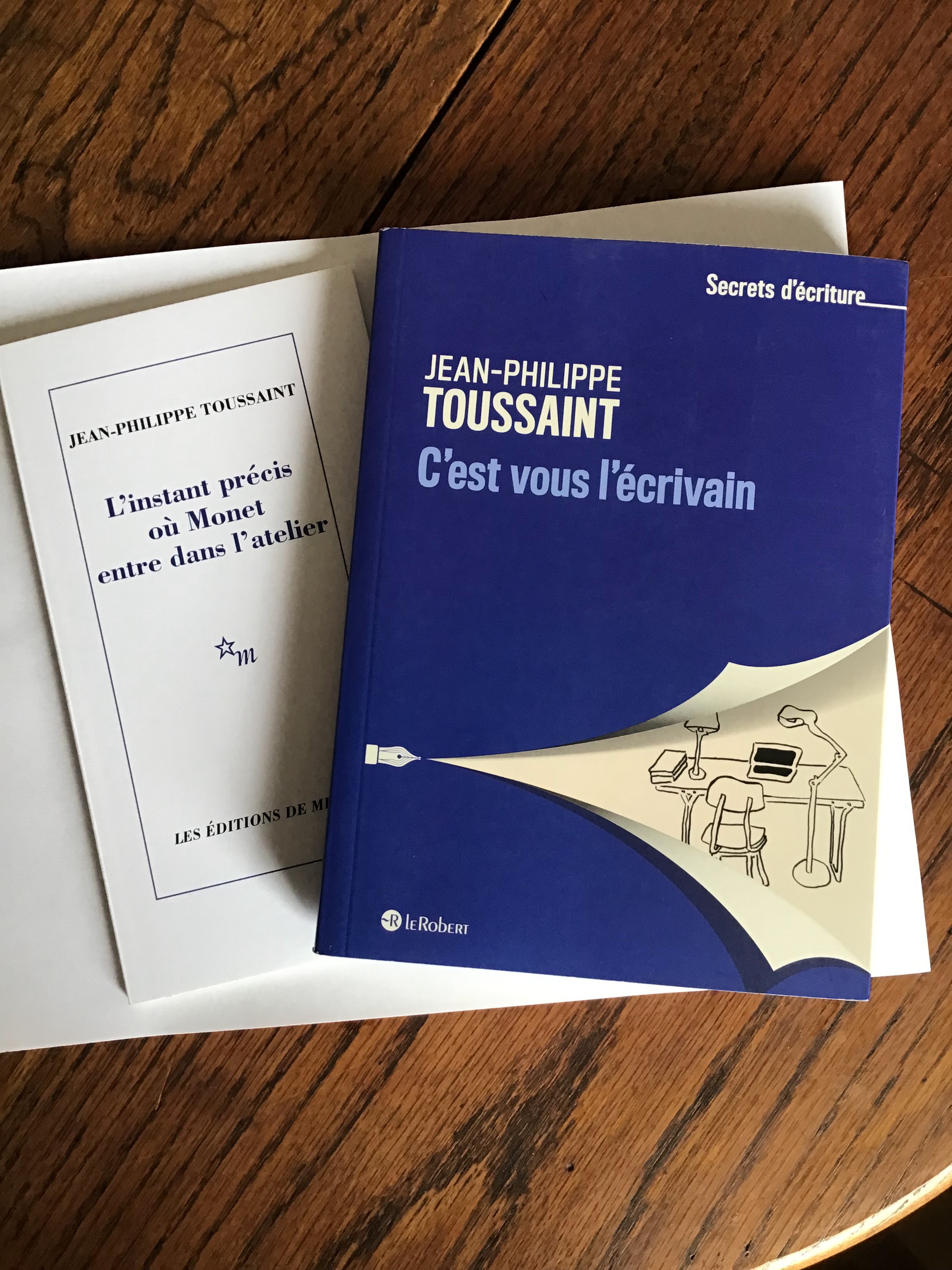
A new book from the French writer Jean-Philippe Toussaint, C’est vous l’écrivain (You are the Writer) takes it title from a remark offered to Toussaint when his first novel was accepted by the legendary Jerome Lindon of Éditions de Minuit, publisher of the nouveau roman of the 1950s. The fledgling author timorously offered Lindon a list of post-acceptance alterations and second-thoughts, fearing that this would be taken wrongly but Lindon coolly replied: “c’est vous l’écrivain,” with the unspoken warning, however, that the writer might propose but, as fearsome editor, obsessed with detail, Lindon’s scalpel would not stay long in its sheath.

Toussaint describes in fascinating detail his own writing methods, the succession of Apple computers he has worked on, each page printed off for intense reworking with a hand-held pen, fonts played with, patterns of text laid out on the page for evaluation (he prints a bizarre example of cramped micro-paragraphs arranged like troops at a dictator’s victory parade), dictionaries ransacked, everything subjected to forensic re-writing. Not for him the astonishingly rapid productivity of Stendhal who could hardly have had time to check for a missed comma (The Charterhouse of Parma’s 500 pages tossed off in 53 days).

Ford Madox Ford, in his characteristically digressive memoir/fiction It Was the Nightingale (1934) confessed that he disliked writing with a pen, in part because of arthritic pain. He was forced to use a new Corona typewriter and even tried dictation to a stenographer – but this made it all too easy: “If I have to go to a table and face pretty considerable pain I wait until I have something worth saying to say it in the fewest possible words.” Ford had put his finger on a crucial need for any writer: to have an invisible antagonist to wrestle with. If it isn’t the product of sweat and toil it has come too easily. Unlike the computer which has made rewriting and re-positioning text so effortless, Ford found insupportable the typewriter’s requirement for him to redo a whole page in order to eliminate a mistake (“I detest a typewriter page showing any corrections”). He went to extraordinary lengths to avoid having to retype, even finding a new context in the words around it for the mistaken word in such a way that it now worked without alteration. But he knew the ultimate truth: “Elimination is always good.”

In the end Ford Madox Ford resolved to return to writing with a pen. His advice to any writer was “in composing make your circumstances as difficult as possible” but erase any mistakes with “bold, remorseless black strokes”.

For Jean-Philippe Toussaint, who began with an Apple LC2 in 1993, and has passed through every ordinateur portable from that stable since then, these years have seen “a silent revolution” in the processing of words which he judges nonetheless as “a natural evolution of the practice of writing” leaving him, however, to speculate about what communications revolution is waiting for his old age.

For my own part, I am grateful that I never learned to touch type, my two-fingered dexterity being quite fast enough, if not quite Stendhalian. As I watch the fingers of others flick like lightning over the keyboard I am relieved that I cannot go any faster. I know that slowness is good for me, hauling me back from the precipice of a too-fluid sentence. As Ovid urged, in another context, lente, lente, currite noctis equi.

But strictures about writing will always retain a certain specious logic. What looks like a rule, a necessity, a universal truth, will turn out to be merely a piece of advice that might work for you but not necessarily for me. Closer to a lucky charm than a law of physics, these strictures aid us in the good work of being hindered, help to convince us that we are on the stony but right track. 

The only immutable law, however, remains the one that should be carved into the marble lintel of every writing school: all writing is re-writing.


Friday, 22 July 2022

Bookbrowsing

The unsurprising surge in online bookselling during lockdown was only the most recent confirmation for many that traditional secondhand bookbrowsing has had its day. 18 pubs close every week according to the Campaign for Real Ale and although no Campaign for Real Books exists to furnish comparable figures it’s clear that shops are continuing either to vanish or to transmigrate online.

Buying books online – though fast, effortlesss and efficient – cannot offer the same serendipitous pleasures of accidental discovery, the gleeful snatch from the shelf of a palpable bargain. In the estimable Cinema Bookshop at Hay-on-Wye recently the four volumes of the beautiful Nonesuch “Coronation Edition” of Shakespeare’s works of 1953 in tip-top condition in a battered slipcase offered themselves at £40, a tenner for each volume. Notwithstanding the line-up of annotated Arden editions at home who could resist such a lovely reading copy on delicate India paper? Or was it the thought of a bargain, confirmed by the flutter to the floor from between the pages of The Merry Wives of Windsor of an invoice for its last change of hands at a posh Mayfair antiquarian book dealer for £130?


Browsing in bookshops is one of those visceral pleasures that has nothing to do with logic or efficiency. In a real shop, too, one at least can handle the real thing and not be disappointed by the arrival of a book that wasn’t what one wanted and turns out to be an ex-library book (that condition not always signalled by the less scrupulous dealers – though I am rather fond of my copy of Eric Auerbach’s classic Mimesis with its big black stamp from Grimsby Public Libraries). Secondhand books come into your hand in all their tactile, olfactory immediacy. You know what you are getting. And online booksellers vary considerably in the accuracy (and honesty) of their sales descriptions. Some, the so-called “bookjackers”, don’t even hold what they advertise (sourcing it later) in order to hook in customers through an obscure manipulation of the process that others will understand better than I.

There is also the pleasure of outwitting the system. Did Oxfam in Leominster really mean me to get an immaculate first edition of Wyndham Lewis’s Blasting and Bombadiering for only £3? Oxfam shops all have their “antiquarian” section which in my experience means “distinctly tatty overpriced older books” – but the word “Oxfam” is better passed over when in the company of independent booksellers who resent its free stock acquisition and prime high street locations which have forced some traditional shops to close.

Online bookselling has probably ended the era of romance in bookselling, dispelling the mystifications of a world once described by Iain Sinclair in an interview as “a masonic society” – which probably reached its apogee in the enigmatic figure of Drif, author of the splendidly opinionated and often downright abusive (and out of print) Drif’s Guide to the secondhand and antiquarian bookshops in Britain. Drif even appears as a fictional character, Dryfeld, in Sinclair’s 1987 novel White Chappel, Scarlet Tracings (“Dryfeld sported a camelhair coat, with lumps of the camel still attached”). No one seems to know who Drif was, and the legends surrounding this sportive “book runner” (his collection of books on suicide, his ending his days in an asylum) are no doubt just that. 

One of Drif’s wittier passages in a Guide that pulled no punches in attacking the often autocratic and customer-unfriendly behaviour of shops was his characterisation of the “roastbeef” end of the trade. This, he explained, meant “hearty, often stout books on hunting, shooting, fishing, polar exploration, fortification, toll booths, coaching inns, bees, clocks, windmills, Churchill, leather bottles, penny whistles, prisons, lazar houses etc etc”. How often has one stepped into such fussy mausoleums.

The internet, in short, is busy taking the quirkiness out of what is left of this putatively raffish business and if you are looking for an out of print book it makes sense, of course, to start with the used book websites, primus inter pares being bookfinder.com which lays out every available example of your sought title and tells you who is selling it and for how much.

Things turn out, however, to be not quite as simple as that.

I recently wanted to acquire a copy of Lorenzo in Taos (1933) by Mabel Dodge Luhan, having seen it feature first in Frances Wilson’s new life of D.H. Lawrence and then underpinning Rachel Cusk’s Booker-shortlisted novel Second Place. It’s out of print and the cheapest version one can acquire online is a print-on-demand new book from Woolf Haus Publishing at £19.99. If you wanted a first edition of the original hardback, probably in less than mint condition, you would expect to pay £40 or £50. Ruminating on these figures I stepped into the Blackheath Bookshop, a premises cruelly attacked thirty years ago by Drif, partly it seems because it looked out onto Blackheath “which is flat, featureless and fouled” which in turn “inspired the owner to make the bksp the same”. Perhaps under new ownership thirty years on, I found it a good enough browsing space and to my delight there was a copy of Mabel Dodge Luhan, the first UK hardback edition from Martin Secker priced at £12. I should add that it was in terrible condition, its spine flapping in the breeze and the binding battle-weary, but the text was clean and clear and it was the latter I was after. Application of some PVA adhesive and a dab or two of the trade’s Backus bookcloth cleaner (“apply with a soft cloth, lightly rubbing in all directions until the surface is evenly revived”) brought it almost back into respectability on my shelf.

The book also had the remnant of an owner’s bookplate and these can bring with them if not a backstory then some sort of intangible addition to the interest of a book. I have Lord Quinton’s New Lines, the classic anthology of Movement verse from 1956 in an excellent hardback first edition bearing his grand heraldic bookplate and (with a more modest signature merely) New Society editor Paul Barker’s copy of the Selected Poems (1968) of R.S.Thomas (acquired by me posthumously from Barker’s local Oxfam shop in Kentish Town).  Both lightly handled. 

Sadder perhaps, two volumes of the Muse’s Library edition of the poems of William Browne of Tavistock donated, says the bookplate, to Birmingham University Library by “Miss L.R. Lewis of Fairfield House, Redditch” in July 1939. She would have assumed that her gift to the university was an everlasting memorial but in the 1990s it was pitched into a crate and shipped off to Richard Booth’s bookshop in Hay where I would be waiting to retrieve it.

I continue to browse the bookshops, more now for the pleasure of accidental discovery than focussed search. They go on existing, like the alleged 18 miles of shelving of the Strand Bookstore in New York City (well, it certainly felt like that sort of distance last time I was there) or the more compact Capitol Hill Books in Washington DC (I left only with its pretty tote bag, not every visit to a bookshop resulting in a fresh catch). In the UK my favourites include Walden Books in Chalk Farm, Any Amount of Books in Charing Cross Road, or Ystwyth Books in Aberystwyth – outfits run by people who love books and have fresh stock flowing through. In Wantage, camouflaged by a second hand furniture shop, Regent Furniture shields a shop with  – a fact that would astonish Drif – a helpful bookseller who bounded all over the shop with irrepressible enthusiasm looking (unsuccessfully) for the book I said I wanted. I lament the loss of the congested Gotham Bookmart on West 47th in Manhattan, of the Marchmont Bookshop in Bloomsbury with its rare poetry collection, and countless other small shops each with their quirky stock and often quirkier proprietor.

I have too many books and am currently weeding the shelves again, introduced only last week to a new app called Ziffit which involves pointing your phone at the barcode of each book until a basketful is priced up (very low prices given but I am just trying to clear space) and a courier arriving next day to bear it away for free. The rest goes to the charity shops, though during and after lockdown many were refusing to accept any more donations, overwhelmed by the lapping tide of printed and bound stuff.

My obsession with books began as a teenager in Liverpool, scanning the shelves of a second hand bookseller on the edge of Chinatown packed with the sort of bread-and-butter inexpensive classics I was beginning to discover at school and university. It was run by a man who always wore a distinctive short white jacket like that of a Cunard ship’s steward. 

His name was Mr Waterston.


Friday, 15 July 2022

Elsewhere: The Collected Poems of Nicholas Murray


I am pleased to announce the publication of my Collected Poems, drawing together all my work to date. It is available from Melos Press where it can be ordered post-free or from here. It is called Elsewhere: Collected Poems of Nicholas Murray after one of the poems in that collection which talks of the contemplation of a painting taking us to “an exalted elsewhere”. This, it seems to me, is what the poetic imagination does: enhances reality (not encouraging us to ‘escape’ from it) transforming and sharpening perception. This is why the arts in general and literature in particular are so essential to human life. Without them we are denuded, less than complete.

Many of the poems are political, sometimes very unambiguously so in the vigorous political satires but sometimes much more obliquely, even invisibly so. And many of the poems are not the least bit political. I hope this makes for diversity and variety and I hope you enjoy the collection.

Here is what the publisher’s blurb says:-

Nicholas Murray’s many books include poetry, two novels, critically acclaimed biographies of Franz Kafka, Aldous Huxley, Bruce Chatwin, Andrew Marvell, and Matthew Arnold, and studies of Liverpool, Bloomsbury and British poets of the First World War. He is a Fellow of the Welsh Academy and, with his wife Sue, runs the prize-winning poetry imprint, Rack Press.

      Nicholas Murray’s poems deal with love and art, humanity, politics, and the natural world in a body of work marked by both passion and fine craftsmanship. David Harsent has written that Murray has ‘a sure hand, whether with hard-edged satire...or sense impressions that produce place and event so vividly’


Praise for earlier collections of poems:

Of earth, water, air and fire ‘A real treat…an elemental menagerie in which the poet’s own delight through verbal magic becomes ours’. Christopher Reid

Get Real  ‘A bravura display of finely controlled outrage.’ Times Literary Supplement

The Museum of Truth  ‘A stunning collection.’ Martina Evans

City Lights  ‘The poems have an emotional intelligence, a wit, that I really admire.’ Michèle Roberts


Monday, 1 November 2021

The Spin Doctor’s Lament


The Spin-Doctor’s Lament


Would that Keir Starmer were more of a charmer:

a dab hand at the glad hand like Barack Obama.

For politics are tough and it’s just not enough

to set out your stall for the tumbled Red Wall

as a principled chap who shrinks from the crap.

Those recently Blue care nothing for you

nor the desperate poor slumped on the floor,

in cardboard cities that no one pities

nor the migrant boats that contain no votes:


‘This is England, mate, where it’s simply too late

to raise the red flag or the spectre of Mag;

we’re the much-courted middle, not Waitrose but Lidl.

To the son of a toolmaker we prefer a wiseacre

whose path was beaten through prep school and Eton

and later the fogeyish groves of The Spectator;

he’s the man for our times and his putative crimes

put nobody off: so give us a toff

any day of the week to a well-meaning geek.’


Wednesday, 9 June 2021

Huxley and Orwell: A New E-Book

 Huxley or Orwell? 

The Battle of the Books.

by Nicholas Murray 

a talk given at the 

Presteigne Festival

23 August 2019


My talk on the rival dystopian visions of Aldous Huxley’s Brave New World and George Orwell’s Nineteen Eighty-Four has just been published as an e-book available FREE from Apple Books.


Friday, 21 May 2021

City Lights: a new poetry collection from Melos

My latest poetry collection City Lights published by the Melos Press is now out.  This wide-ranging and versatile 32-page pamphlet collection contains the longer sequences “The Song of Rhodri” (the voice of an imaginary medieval Welsh bard) and “The World Tree” (poems about trees in myth and reality drawing on Norse legend) as well as poems of contemporary political resonance. From the Welsh countryside to Washington DC and all points in between these poems are both lyrical and engaged.

My recent collections, A Quartet in Winter and The Yellow Wheelbarrow can also be ordered here.


Wednesday, 27 January 2021

St Valentine’s Day approaches


This month’s Reader’s Recommendation from Seren Books. 20 years old and still available for 14th February.  “This mult-faceted jewel is a reader’s delight,” said The Independent on publication.

Wednesday, 8 July 2020

The latest issue of Scintilla, the annual journal of the Vaughan Association has just appeared and once again it has a wide selection of contemporary poetry as well as articles related to its area of interest. I have three poems in this issue.

Monday, 22 June 2020

Manchester Review praises The Yellow Wheelbarrow

The latest Manchester Review includes a review of The Yellow Wheelbarrow by Ian Pople:

Nicholas Murray has also shown himself to be a fine satirist, as his poem A Dog’s Brexit, showed so well. The Yellow Wheelbarrow is a full-length collection of work and includes work from previous pamphlets as well as new work. Murray the satirist is represented here with such poems as ‘We Must Avoid Cliché’, which, as you might imagine, does not avoid cliché, particularly where the ‘poe-biz’ is concerned.
"This long awaited first collection./Long-touted on Twitter by its friends,/its enemies not yet found, still to stir/from their long sleep of indifference."
What is present even in these lines whose purpose is, perhaps, ‘political’ with a small ‘p’, is the quiet rhythmic pulse with underpins all Murray’s poems.
That assured rhythmic control is often allied with a closely observational sense in Murray’s writing. And the final effect of this combination is a warm lyrical quality to these texts. The poem, ‘Venus’ depicts the painting of a nude by Cranach the Elder in the painter’s studio, in the dead of winter, ‘where ice made dragons // on the window-pane / and lust froze up before the twist / of water left the opened tap.’ Murray’s deft imagination creates the strikingly visual image of the ice making ‘dragons’ on the window. Then he yokes the freezing of lust with the unfrozen water in the tap; and does so, in part, with that nice half-rhyme of ‘lust’ and ‘twist’.
Perhaps Murray’s satire is a natural development of that other ability his poetry has, an ability to look at a scene and depict it with real emotional precision. In that way, Murray’s lyrics share the laser like focus of his satire. The emotional precision of Murray’s poems drive the quiet narrative that leads the poems. And in that precision there is a feeling of what might be right entwined with what might be possible, as in the poem ‘Island’, which is here quoted in full:
Brendan’s monks have lit a fire
where gutted fish brown on whittled sticks,
and God is thanked for the air of a small island.
There is no hint of what’s to come:
the slide of embers, the tilt and scatter
when the whale lifts itself from seeming sleep.

Tuesday, 15 October 2019

The Yellow Wheelbarrow


My new collection of poems from Melos was published on 4th November and launched in London on 3rd December 2019. It is available from Melos post free or you can obtain a copy here (see drop down menu to the right).

The title alludes to “The Red Wheelbarrow”, the famous poem by the modernist American poet William Carlos Williams.


Some Critical Opinion:-

"'The Migrant Ship' and 'Calais' seem to be masterpieces of metaphor for our ghastly times.”
                Paul Binding

"A remarkable collection, in that Murray’s talent for the nuances of rhyme works effortlessly into his political satire, and some truly moving poems of love.”
              John Powell Ward

"A fine and remarkably varied book.”
              Anthony Rudolf

"The collection riveted me from the very first poem.”
              Ruth O’Callaghan


Monday, 8 July 2019

Who Was the Better Prophet? Huxley or Orwell?

PRESTEIGNE FESTIVAL 2019


Event 6

Friday 23 August at 4.00pm 
Assembly Rooms, Presteigne LD8 2AD

Dydd Gwener 23 Awst am 4.00pm
Yr Ystafelloedd Cynnull, Llanandras LD8 2AD

Huxley or Orwell? The Battle of the Books

Literature with Nicholas Murray

Nicholas Murray, biographer of Aldous Huxley, looks at the competing claims of the two great twentieth century dystopian novels, Brave New World and Nineteen Eighty-Four. Which predicted more accurately the way the world was heading in their time and ours? Was Huxley’s book, predicting a consolidation of ’soft power’ in Western consumer societies more accurate in the world of Facebook and Google than Huxley’s darker vision symbolised by the famous image of the jackboot on the face?

Tickets £7.50 unreserved 
Tocynnau £7.50 heb eu cadw 

Event ends at approximately 5.15pm
Bydd y digwyddiad bwn yn gorffen am tua 5.15pm


Friday, 8 March 2019

Rack Poets Reading on Film


Follow this link for a fantastic film of our poets reading from the new pamphlet. Released today by Doorway Films for International Women’s Day.


Thursday, 7 February 2019

Depressed? Moi? Houellebecq’s Sérotonine

Gare du Nord Eurostar Lounge two days
after publication; not yet quite in the top 10
  When the French author Michel Houellebecq’s agent, François Samuelson, warned him that his new novel (published 4 January) would provoke a reaction from feminists the novelist, practised in the art of provocation (rompu à l’art de la provocation as Le Monde put it) replied in his customary sardonic fashion: “Elles sont moins dangereuses que les islamistes.”
   Feminists are not the only ones to have been disapproving of the contentious writer in the past. He is indeed expert in upsetting people (something once considered an essential faculty in the writer; this author’s name is an extended 'trigger warning'). On cue he told Harper’s Magazine just before publication that Trump was the best President ever. I doubt if he believes that for a moment but it was time to bait the Parisian liberal commentariat.
   Yet he is popular. Translated into countless languages, his latest book, when I arrived in Paris recently two days after publication, had sold out in the first bookshop I tried but fortunately was heaped up on the counter everywhere else. At the lovely Écume des pages bookshop in the Boulevard St Germain the woman ahead of me in the queue was handling it tentatively, trying to make up her mind, as if there were a possible toxicity that she should be wary of. The bookseller understood her hesitation. He had read the first 40 pages, he said, and was willing to recommend it. Ok, she said, I’ll take one. Contrast that with the lack of animation with which we pick up the latest Costa or Man Booker garlanded fiction.
   Are feminists right? Is he a menace to women as well as all the other targets in his new book: the ecologically aware, the proprietors of smoke-free hotels, the architects of the common agricultural policy etc etc? I hesitate to say this but I thought I detected something that almost resembled mellowness. (The author has recently married for the third time, to Qianyum Lysis Li, and sent Le Monde his wedding photos in lieu of an author profile, dressed in a fetching grey morning suit and topper.) Set aside the childish contrarianism and the predictable winding-up that constitute the Houellebecq media persona in his shabby parka (already compared in Private Eye to David Threlfall in Shameless) and read the new book and I think something else emerges. This waspish observer can also write:

 Le monde extérieur était dur, impitoyable aux faibles, il ne tenait presque jamais ses promesses, et l’amour restait la seule chose en laquelle on puisse encore, peut-être, avoir foi. [The real world was hard, pitiless to the weak, it hardly ever delivered what it promised, and love remained perhaps the only thing in which one could still believe.]

Not quite a nihilist?
   The novel is called Séretonine and the narrator (let’s not fall into the obvious trap of equating him with the author though the temptations are strong) is a late 40s depressive on a medication called Captorix. The drug has left him in a state of anomie without any sexual desire, which considering the central role rather explicit sex has played in his previous six novels is a novelty. There are a couple of perfunctory erotic scenes but they are not on the former scale.  Florent, the narrator, lives regretfully at having lost through his own selfishness and stupidity Camille, one of the women in the book who are represented, I would say, in a very positive way. He tracks her down to her vet practice in northern France where she is successful, has a small child, and lives in a pleasant house by a lake. Florent realises that the love he could have enjoyed with her is now entirely focussed on her child. “It is him or me,” he reflects and the child wins out.
   In contrast the relationship he has with Yuzu, a remarkably (and comically, for a sense of humour is essential to appreciate Michel Houellebecq) selfish Japanese whom he eventually escapes from by secretly terminating the lease on his flat and moving into a Paris hotel and later a soulless flat in a tower block, is almost wholly dysfunctional and the separation does neither any harm. His job as a freelance agronomist working for the ministry of agriculture with the specific brief of marketing Normandy cheeses takes him to that region where he connects with an old university friend, Aymeric. The latter is heir to a landowning family but, like his fellow dairy farmers, simply cannot make the farm work (I won’t spoil the plot by recounting how all that is resolved). His wife runs off with a visiting pianist, dumping both the struggling and desperate Aymeric and her two small children, so the word salope which you and I are too delicate to use might be appropriate in the circumstances. And there you have it. All the other women in the story, from old flames to hotel receptionists, are presented in ways that I cannot see anyone finding objectionable.
   The great appeal of Houellebecq’s writing to me is its contemporaneity. He is writing about Europe now. His description, for example, of a vast Normandy Leclerc supermarket is both accurate and funny. His eye for detail, sardonically presented, gives the book, in spite of its sombre subject matter (a depressed middle aged man contemplating suicide as the only way out) a richly humorous flavour.
    I laughed a lot.