"Murray is the best kind of literary biographer" – The Financial Times.
For more information about the books of Nicholas Murray
click HERE and access his website
Winner of the 2015 Basil Bunting Award for poetry

Friday, 20 July 2012

Hype and the World of Books

John Banville's new novel Ancient Light, which comes with a perfectly intelligent and sensible blurb carries also on the front cover a comment of a kind that makes one wonder about the people who work in book marketing (in this case Penguin Viking).  It is one of those pre-emptive puffs of which the trade is so fond (the book had not been published and not reviewed when this was set in type) and it comes from Sebastian Barry: "Could any book be better? Did it even need to be as tremendous as this?"  Yuk!  This is indeed (despite the haughty reservations of today's TLS) a very good book and I loved it but what is the point of a silly piece of overstatement like this? Did the wry and self-mocking Banville approve it? (My guess is no, authors, like everyone else in publishing, are subservient to sales and marketing.) One could multiply examples of this sort of thing with ease and what a contrast with other countries. Like France, for instance.

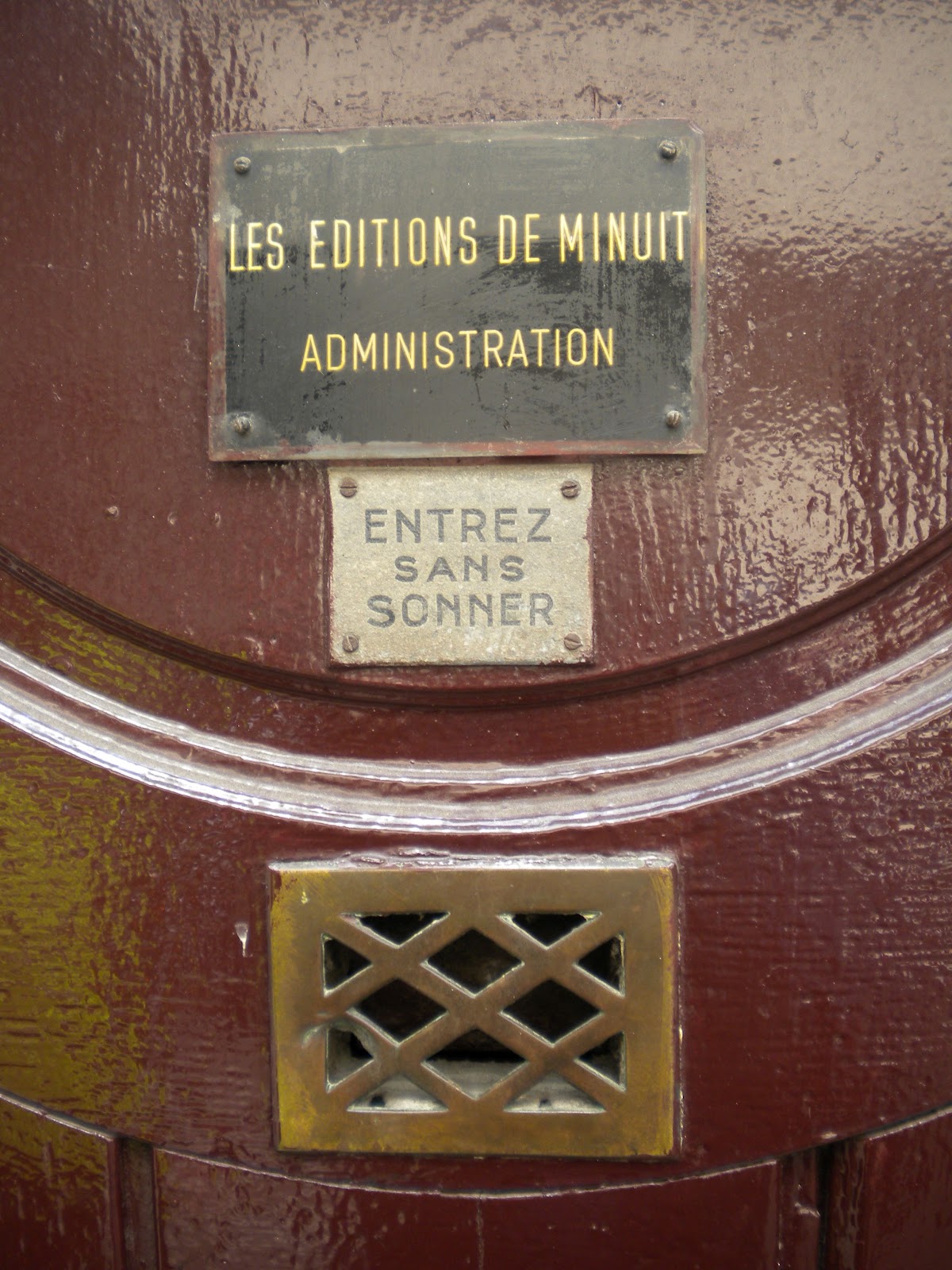
In Paris recently I paid the visit of a pilgrim to rue Bernard Palissy on the Left Bank which is the HQ of Les Editions de Minuit, one of the finest French publishers with a small but always distinguished output.  Rue Bernard Palissy is a little back street blocked when I walked into it by a large van which was unloading into the rear of a building, cancelling any hint of chic. Minuit's offices consist of a small window which was modestly featuring Jean-Philippe Toussaint's Autoportrait (à l'étranger) and not much else.  Toussaint's characteristically spare and elegant book of impressions of Japan, Berlin, Prague etc has just been re-issued as a paperback in the "Collection 'double'" series.  The mark of this publisher has always been an austere minimalism of design, plain white covers, no illustration, no author photographs, no prolix blurbs etc.  The tacit assumption is that all one needs is to read the book and all one learns about the author is contained in one sentence: "Jeanne-Philippe Toussaint est né à Bruxelles en 1957. Il est écrivan et cinéaste."  For the paperback a concession has been made and we have a discreet one line quote from the Libération reviewer and, on the cover, a photograph! It is a reflection in a shop window of the author in Tokyo taking a snap of himself in the rain under a transparent polythene umbrella.  But that is as far as it goes.

To the left of the display window is a battered maroon painted door (see picture) which merely says "enter without ringing".  No glitz, no life size cardboard cutouts of Samuel Beckett, no potted plants, no Sloaney receptionists.  Just a small house which publishes exquisite fiction (too little of it translated into English) and leaves it at that.

Thursday, 12 July 2012

Please Mention the War

The paperback of my book about the British poets of the First World War, The Red Sweet Wine of Youth, is published at the end of the month and you can order it now (the Amazon link is here to the right of this page if you prefer to buy it that way).  I hope it's a concise and useful account of a dozen of the main poets and the literary background from which they emerged.  Like many British schoolkids I was brought up on Owen & Co and poems like his "Dulce et Decorum Est" which, we were told, expressed "the horrors of war".  They certainly did that and the horrors of the trenches need no embellishment but I try in the book to give what I hope is a little more nuanced view of the poets' attitude to war and in particular I try to represent Sassoon's protest against the war in what I also hope is a more accurate way than it is often represented.  I hope you enjoy the book.

Tuesday, 19 June 2012

Robert MacFarlane: The Old Ways

It takes a certain amount of chutzpah in these days when publishers are jumpily fashion conscious to risk a seemingly conservative title like The Old Ways but Robert MacFarlane is merely exercising his fondness for word play and his subject is not a Michael Gove-inspired return to basics but an exploration of the ancient pathways that thread the landscape at home and abroad.  It is about his explorations of those long distance paths like The Ridgeway (which years ago my wife and I followed in pouring rain for three days with a tent on our back) or the Icknield Way but also paths in Tibet, Palestine, Spain and indeed their watery equivalents, the seaways of the Outer Hebrides.  The subtitle is "A Journey on Foot" but this is a book about many journeys on foot in many places and in many weathers.

One of MacFarlane's central arguments is that we are made by landscape as much as we might think we make landscape by gouging our tracks across it.  There is, he implies, a dialogue going on between us and our feet and the ground we walk on, the geology under us and the skies above and the past is very much present on these old ways, shaping us, making us what we are, changing us.  At one point he chooses for a chapter's epigraph a quote from two recent authors, Tim Ingold and Jo Lee Vergunst: "Since to follow a trail is to remember how it goes, making one's way in the present is itself a recollection of the past...onward movement is itself a return."  The book has a pleasing architecture and MacFarlane has a fine and vivid gift for making all those landscapes come alive.  His description of a walk on the Broomway which connects, notoriously and treacherously, the island of Foulness to the coast of eastern England is a tour de force of subtle descriptive writing.

In a characteristically over-the-top review of this book in The Observer William Dalrymple recently tried to fit MacFarlane up with the mantle of Bruce Chatwin but it turns out that the latter is dismissed very early on with a curt reference to his "flawed" thesis in The Songlines. Why or how it is flawed the reader isn't told but there are many stylistic features of the book that call Chatwin to mind: the habit, for example, of arriving at a place and instantly connecting with "my friend X" who just happens to be the global authority on the pertinent aspect of the place and also possessed of incalculable gifts of intellect, scholarship, facility in languages etc etc.  In this school of travel-writing one never spends time with the ordinary or the ungifted person.  There is a classic passage on p276 ("I asked Jon about the lives of the early Buddhist saints...") where the sort of dialogue never heard outside a seminar room is fully reproduced in the way that Chatwin loved to do.  Actually, I don't mind because this is a highly informative book from which I learned a great deal and MacFarlane, a fellow of a Cambridge college, putative new Chatwin or not, turns out to be a very companionable guide, who doesn't take himself more seriously than he is entitled to and whose book is the product of much walking, much reading about walking, and much reflection. This gives it a mellowness and richness that adds to its charm.

MacFarlane is very much taken with Edward Thomas (who has been making quite a comeback recently with the reading public) and that poet's ideas about memory and landscape both being "in flux".  The connections between past and present, landscape and mind, in Thomas's writing fit very well with MacFarlane's own obsessions.  Like Roger Deakin another knowledgeable man in the woods, MacFarlane writes informatively but also very personally about his own experiences (nearly freezing to death in Tibet, having a scary night in the haunted Chanctonbury Ring etc) and I found this a hard book to put down as reviewers of whodunnits say.

And what a co-incidence that it should end at exactly the same place that Jean Sprackland's recent book Strands* ended: on the beach at Formby, north of Liverpool where some remarkable fossilised neolithic footprints have re-emerged from the sand – giving a nice closing metaphor of print/footprint, past/present as the author measures his footprint against that of a prehistoric hunter gatherer.

This is the third of what MacFarlane calls "a loose trilogy" of books on mountains and wild places and I will certainly be backtracking to get those earlier volumes.
_________________________________________________________

*my review of Sprackland's book will be appearing shortly in The Independent
Wednesday, 6 June 2012

Field Works

Ceaseless rain but the flower books say that this Cuckoo Flower (aka Lady's Smock and Milkmaid; cardamine pratensis) is "damp-loving".  It looked beautiful this morning in its soggy Radnorshire field.

Tuesday, 29 May 2012

The Campaign Against Real Writers

I have just read a short but very effective piece in the latest New York Review of Books by Jonathan Mirsky on the scandal of the London Book Fair last month which was dominated by Chinese authors – but only those permitted to be there by the censors acting in concert with the book fair's organisers and the British Council.  Excluded were any writers not approved of by the Chinese censors.

"We must be very powerful and they are frightened of us, said Qi Jiazhen, a septuagenarian Chinese writer who took part in a protest meeting of the excluded.  The British Council's director of literature claimed that the officially permitted writers were more 'representative' because "they live in China and write their books there" in contrast to the "other writers who have left".  This is the official Chinese censors' line but it raises a number of interesting questions.  Does it mean that Joyce, Becket, Hemingway, Kundera, to choose some names at random from the long list of writers who have lived and worked out of their own countries, were somehow not real writers, not part of their originating culture and language?  Are the only writers worthy of our attention the ones who stay at home or the ones who make themselves acceptable to the government of the day?  And what is the British Council, an organisation dedicated to spreading culture beyond these shores, doing advocating such a grotesque idea?

"What's happening is that countries are becoming companies. And that's what the British Council is already, just a company cooperating with the Chinese company," Mirsky quotes one leading Chinese poet, Yang Lian, as saying.

There are, as it happens 35 Chinese authors who are not likely to be decamping to Paris shortly to write their books.  That is because they are in jail for the words they have written.

Sunday, 13 May 2012

Are you a liberal?

Thank you to the Gladstone Library for making me think about liberalism (with a mandatory small 'l' in these Coalition times).  Here is my contribution to their exploration of the theme.  They have been looking for people who will say why they are or are not liberal and those who reject the notion are seemingly rather thin on the ground.  Perhaps this is the problem with this noble cause; like motherhood and apple pie no one can find an argument against it.

Tuesday, 24 April 2012

Launch of Acapulco by Nicholas Murray

An enjoyably convivial evening to mark World Book Night last night through the launch of my new poetry collection, Acapulco (see previous post for details).  Here I am reading from the book (available online from Melos Press) watched by Peter Tatchell who was the dedicatee of one of the poems in the collection, 'Courage'.  The poem was suggested by Peter and friends' courageous defiance of the bigots of Moscow who attacked the gay pride demonstrators while the forces of 'law and order' looked the other way.


Courage
for Peter Tatchell
Today is the day
to clean the streets
of the gay-proud.
The shavenskulls slip
like loosed dogs
into the chanting crowd
to scatter their mayhem
under the benevolent eye
of the ‘security forces’
whose black boots
firmly cleave to
the frozen ground.
It is the mania of hatred:
each lashing out 
at what he fears
like a man whose wild hands
fight off a swarm
of angry bees.