Tomorrow is the centenary of one of the more remarkable moments of 20th century literature when, through the night of 22/23 September 1912, Franz Kafka wrote his breakthrough story, Das Urteil, ("The Judgement"). He wrote it, as he said afterwards, "in einem Zug" or "in one go". One translator is said apocryphally to have rendered this as Kafka having written it "on a train" (Zug being the same word for both). It is wonderful to read, in Kafka's diaries, his description of the joy of this creation, how he was carried away by it, how he felt suddenly that "everything could be said" ("Wie alles gesagt werden kann"). Whatever else Kafka was, he was, for me, the supremely dedicated writer of his century, who was interested not in fame, "deals", "exposure", and all the other things that are urged on young writers as their goal, but the act of writing itself, its beauty and agony, its needfulness. "The conviction verified," he wrote in the aftermath of the story, "that with my novel-writing I am in the shameful lowlands of writing. Only in this way can writing be done, only with such coherence [Zusammenhang], with such a complete opening out of the body and the soul."
I won't say any more about the story itself but I suggest you join me in reading it in silent tribute tomorrow night.
Just now there is a little flurry of correspondence in the Times Literary Supplement following a review by Gabriel Josipovici of some recent books on Kafka in which Josipovici expressed some discontent (I oversimplify his argument) with critics who think they have finally captured Kafka's meaning. I have some sympathy with him. Kafka's greatness is partly due to the fact that we cannot neatly sum up what he was "saying". The mystery, the never quite knowing, is what constitutes the peculiar appeal of his writing. I have written a biography of Kafka and you can order it by clicking on the dreaded Amazon box to the right of this column but, in truth, biography can point to certain correspondences in the story with Kafka's life and can contextualise it usefully but it cannot explain its magic. Reading it to his sister when it was still fresh she said that the house in the story was like theirs: "I said: How? In that case, then, Father would have to be living in the toilet."
Once again Kafka has the last word.
"A precondition for reading good books is not reading bad ones: for life is short" - Schopenhauer.
Friday, 21 September 2012
Tuesday, 18 September 2012
Acapulco Reviewed
I have just returned from northern Italy to find a review of my poetry collection Acapulco: New and Selected Poems (Melos) by Martina Evans on Writer's Hub and another by John Greening which I hope the TLS won't mind my reproducing here:-
"There is often a single poem early in a collection that helps the reader find their way. In Acapulco by Nicholas Murray, it is "Bedroom", about a painting by Vilhelm Hammershoi: "How you anticipate / our love of the minimal ...", it begins, concluding a few lines later: Your silence grows in us, expands like rising dough, until we reach the street and find ourselves, altered, in an exalted elsewhere. That heavy cadence is characteristic, as is the sound-shift from "altered" to "exalted". In Murray's strongest work the effect is exactly as described in "Bedroom". The silence can be that of "Honfleur" - "amongst smiling gourmands /who do not know our secret"; the more spiritual regions of "Icon", the opening poem; or raw and malevolent - most vividly in a piece about an owl ("That cold, accusing look!") accidentally smoked from its nest. "Owl" is Murray at full stretch. "Get Real!", his extended satire on the Coalition (as the biographer of Andrew Marvell, he can be forgiven for trying) is less successful than pieces where the mockery is reined in: his snaps of Liverpool ("Culture Capital" - Murray has also written a Life of Matthew Arnold), for example, or the gentle pokes at archaeology, photographers, cyclists ("chasing pleasure, with the grimness it deserves") and even writers in "Himself a Poet": Oh yes, we all know the truthfulness of blurbs: like the grocer's insistence that his gnarled loaf with its scatter of grains, signalling wholesomeness, was not drawn, craftily, from the freezer at dawn. Shakier in descriptive work such as "First Day of Summer", where "cooing pigeons" reappear from two pages earlier, Murray is at his best when least adjectival, when a poem feels like a "tossed titbit", one of those "buoyant scraps" fed to appease those same "pigeons in the square". He frequently emphasizes the importance of selection, knowing what and when to exclude - the minimalist title poem, for instance, is rounded off (again somewhat over-emphatically) with the idea of a "viewfinder getting in the way of the view", but also more sinisterly in "Der Führer", where Hitler "ordered that the blinds be drawn" when his train was passing bombed cities."
From the Times Literary Supplement, 14 September 2012
Tuesday, 4 September 2012
Warwick Review and Acapulco
The latest issue of The Warwick Review has been published and contains the usual rich variety of poems, fiction, and reviews.
I was particularly pleased the have a review of my latest poetry collection, Acapulco (Melos) by Jackie Wills. Here is what she said:
After referring to the poet's "taut precision" which "can spill into satire or deliver meticulous detail" she went on:
"Murray is an acclaimed biographer, novelist, runs Rack Press and is a Fellow of the Welsh Academy. This collection contains 25 new poems and selected work from two previous collections, Plausible Fictions and The Narrators Murray's range is eclectic and within the new poems, unsurprisingly, his political voice is present. He tackles pollution with stark imagery in 'Food', homophobia in 'Courage', and racist violence in 'Culture Capital'. Later in the collection, his furious satire 'Get Real' takes on contemporary politics in the fine tradition of poets as diverse as Alexander
Pope, Linton Kwesi Johnson and the late Peter Reading. Murray's tight style, at its best in the first verse from 'Food', serves his politics well:
On Midway Atoll they spread out the infant albatross:
its stomach slit to show the bellyful of plastic trash
that parents plucked from the polluted sea as food.
In the older sequence 'Greek Islands', Murray’s brevity delivers a sense of transience, of visual pleasure, of moments attached to places like tiny threads or found objects. These poems are as beautiful and challenging as the newer poem 'Island Swimmer', in which the subject, an older woman, easily outpaces the narrator, her body emulating "the action of the eel". At times, among the many subjects this collection tackles, there is a sense of the fragility of relationships, and, while Murray's a careful writer, occasionally his language leans towards the archaic. But the wry title poem, ‘Acapulco’, is another that shows him on form, condensing the image – "the tower blocks gather to the contemplation of blue” – and setting pelican against tourist.
Subscribe now to The Warwick Review by emailing: m.w.hulse@warwick.ac.uk.
Tuesday, 14 August 2012
Art and Sand
Anthony Gormley's installation at Crosby Beach, Liverpool, Another Place, known locally as The Iron Men was meant to be removed in 2006 but the locals protested and wanted it kept. Ever since I first saw it I have been entranced by the way this human construct changed the whole natural landscape of this beach which was my childhood playground. One of the poems in my recent collection Acapulco (Melos Press, see elsewhere on this page on how to order) called "Culture Capital" has a passage on the installation and the way in which people have added, as in this photograph, their own embellishments to the work. The individual iron men (based I believe on a cast of Gormley's own body) are rusting and acquiring barnacles as well as impromptu headdresses so perhaps they won't last for ever but the idea was an inspiring one and I salute it.
PS to my friends who have not seen anything from me recently on Facebook or Twitter, an explanation. I tried to throw myself into this world, I really did, but the tsnunami of trivia and narcissism finally swept my corpse out to sea and I am there no longer, except for Rack Press posts when necessary and sending links to Twitter for these blog posts. I must say I feel a lot better without the daily dose of it.
Friday, 20 July 2012
Hype and the World of Books
John Banville's new novel Ancient Light, which comes with a perfectly intelligent and sensible blurb carries also on the front cover a comment of a kind that makes one wonder about the people who work in book marketing (in this case Penguin Viking). It is one of those pre-emptive puffs of which the trade is so fond (the book had not been published and not reviewed when this was set in type) and it comes from Sebastian Barry: "Could any book be better? Did it even need to be as tremendous as this?" Yuk! This is indeed (despite the haughty reservations of today's TLS) a very good book and I loved it but what is the point of a silly piece of overstatement like this? Did the wry and self-mocking Banville approve it? (My guess is no, authors, like everyone else in publishing, are subservient to sales and marketing.) One could multiply examples of this sort of thing with ease and what a contrast with other countries. Like France, for instance.
In Paris recently I paid the visit of a pilgrim to rue Bernard Palissy on the Left Bank which is the HQ of Les Editions de Minuit, one of the finest French publishers with a small but always distinguished output. Rue Bernard Palissy is a little back street blocked when I walked into it by a large van which was unloading into the rear of a building, cancelling any hint of chic. Minuit's offices consist of a small window which was modestly featuring Jean-Philippe Toussaint's Autoportrait (à l'étranger) and not much else. Toussaint's characteristically spare and elegant book of impressions of Japan, Berlin, Prague etc has just been re-issued as a paperback in the "Collection 'double'" series. The mark of this publisher has always been an austere minimalism of design, plain white covers, no illustration, no author photographs, no prolix blurbs etc. The tacit assumption is that all one needs is to read the book and all one learns about the author is contained in one sentence: "Jeanne-Philippe Toussaint est né à Bruxelles en 1957. Il est écrivan et cinéaste." For the paperback a concession has been made and we have a discreet one line quote from the Libération reviewer and, on the cover, a photograph! It is a reflection in a shop window of the author in Tokyo taking a snap of himself in the rain under a transparent polythene umbrella. But that is as far as it goes.
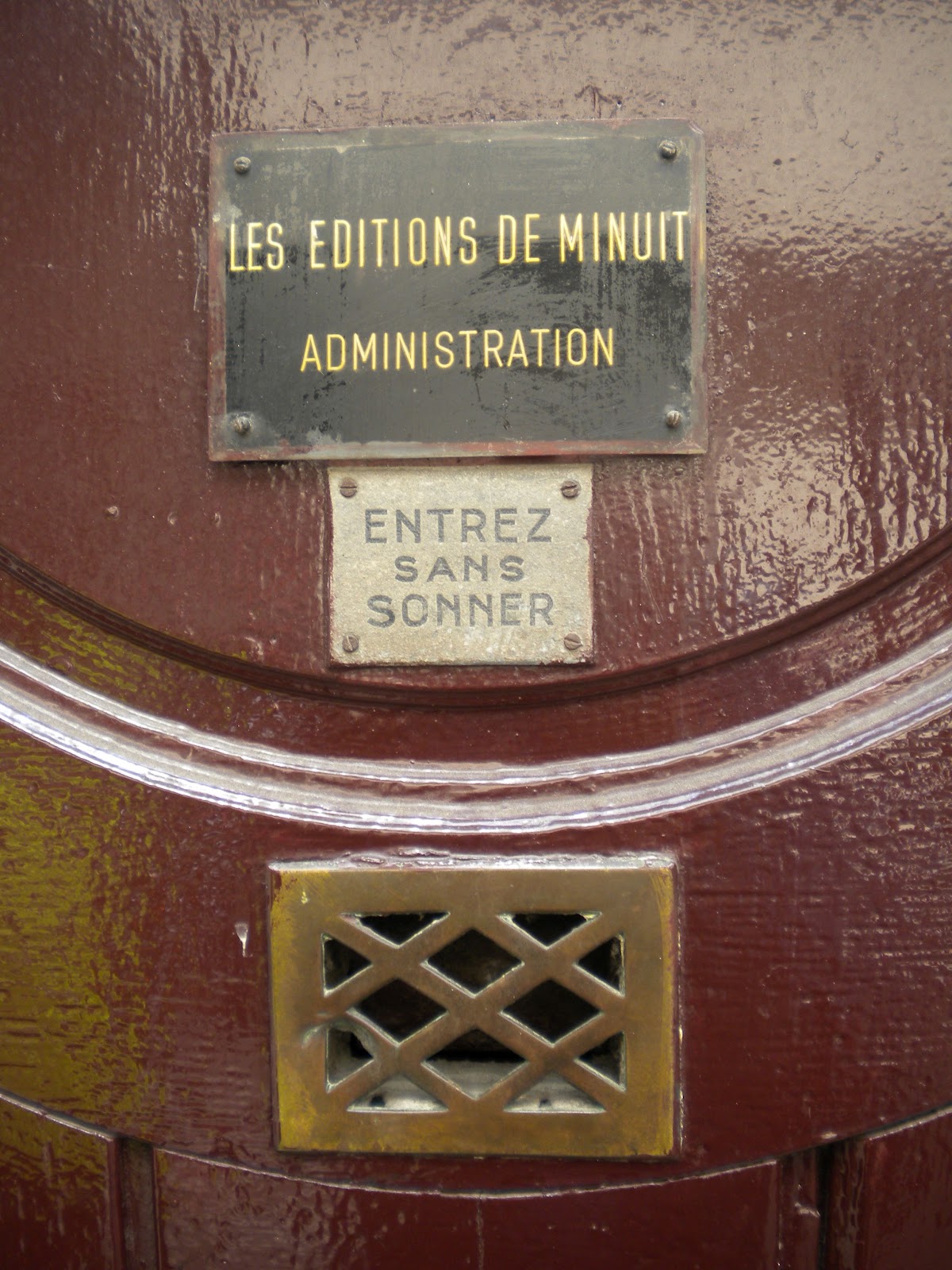
To the left of the display window is a battered maroon painted door (see picture) which merely says "enter without ringing". No glitz, no life size cardboard cutouts of Samuel Beckett, no potted plants, no Sloaney receptionists. Just a small house which publishes exquisite fiction (too little of it translated into English) and leaves it at that.
In Paris recently I paid the visit of a pilgrim to rue Bernard Palissy on the Left Bank which is the HQ of Les Editions de Minuit, one of the finest French publishers with a small but always distinguished output. Rue Bernard Palissy is a little back street blocked when I walked into it by a large van which was unloading into the rear of a building, cancelling any hint of chic. Minuit's offices consist of a small window which was modestly featuring Jean-Philippe Toussaint's Autoportrait (à l'étranger) and not much else. Toussaint's characteristically spare and elegant book of impressions of Japan, Berlin, Prague etc has just been re-issued as a paperback in the "Collection 'double'" series. The mark of this publisher has always been an austere minimalism of design, plain white covers, no illustration, no author photographs, no prolix blurbs etc. The tacit assumption is that all one needs is to read the book and all one learns about the author is contained in one sentence: "Jeanne-Philippe Toussaint est né à Bruxelles en 1957. Il est écrivan et cinéaste." For the paperback a concession has been made and we have a discreet one line quote from the Libération reviewer and, on the cover, a photograph! It is a reflection in a shop window of the author in Tokyo taking a snap of himself in the rain under a transparent polythene umbrella. But that is as far as it goes.
To the left of the display window is a battered maroon painted door (see picture) which merely says "enter without ringing". No glitz, no life size cardboard cutouts of Samuel Beckett, no potted plants, no Sloaney receptionists. Just a small house which publishes exquisite fiction (too little of it translated into English) and leaves it at that.
Thursday, 12 July 2012
Please Mention the War
The paperback of my book about the British poets of the First World War, The Red Sweet Wine of Youth, is published at the end of the month and you can order it now (the Amazon link is here to the right of this page if you prefer to buy it that way). I hope it's a concise and useful account of a dozen of the main poets and the literary background from which they emerged. Like many British schoolkids I was brought up on Owen & Co and poems like his "Dulce et Decorum Est" which, we were told, expressed "the horrors of war". They certainly did that and the horrors of the trenches need no embellishment but I try in the book to give what I hope is a little more nuanced view of the poets' attitude to war and in particular I try to represent Sassoon's protest against the war in what I also hope is a more accurate way than it is often represented. I hope you enjoy the book.
Tuesday, 19 June 2012
Robert MacFarlane: The Old Ways
It takes a certain amount of chutzpah in these days when publishers are jumpily fashion conscious to risk a seemingly conservative title like The Old Ways but Robert MacFarlane is merely exercising his fondness for word play and his subject is not a Michael Gove-inspired return to basics but an exploration of the ancient pathways that thread the landscape at home and abroad. It is about his explorations of those long distance paths like The Ridgeway (which years ago my wife and I followed in pouring rain for three days with a tent on our back) or the Icknield Way but also paths in Tibet, Palestine, Spain and indeed their watery equivalents, the seaways of the Outer Hebrides. The subtitle is "A Journey on Foot" but this is a book about many journeys on foot in many places and in many weathers.
One of MacFarlane's central arguments is that we are made by landscape as much as we might think we make landscape by gouging our tracks across it. There is, he implies, a dialogue going on between us and our feet and the ground we walk on, the geology under us and the skies above and the past is very much present on these old ways, shaping us, making us what we are, changing us. At one point he chooses for a chapter's epigraph a quote from two recent authors, Tim Ingold and Jo Lee Vergunst: "Since to follow a trail is to remember how it goes, making one's way in the present is itself a recollection of the past...onward movement is itself a return." The book has a pleasing architecture and MacFarlane has a fine and vivid gift for making all those landscapes come alive. His description of a walk on the Broomway which connects, notoriously and treacherously, the island of Foulness to the coast of eastern England is a tour de force of subtle descriptive writing.
In a characteristically over-the-top review of this book in The Observer William Dalrymple recently tried to fit MacFarlane up with the mantle of Bruce Chatwin but it turns out that the latter is dismissed very early on with a curt reference to his "flawed" thesis in The Songlines. Why or how it is flawed the reader isn't told but there are many stylistic features of the book that call Chatwin to mind: the habit, for example, of arriving at a place and instantly connecting with "my friend X" who just happens to be the global authority on the pertinent aspect of the place and also possessed of incalculable gifts of intellect, scholarship, facility in languages etc etc. In this school of travel-writing one never spends time with the ordinary or the ungifted person. There is a classic passage on p276 ("I asked Jon about the lives of the early Buddhist saints...") where the sort of dialogue never heard outside a seminar room is fully reproduced in the way that Chatwin loved to do. Actually, I don't mind because this is a highly informative book from which I learned a great deal and MacFarlane, a fellow of a Cambridge college, putative new Chatwin or not, turns out to be a very companionable guide, who doesn't take himself more seriously than he is entitled to and whose book is the product of much walking, much reading about walking, and much reflection. This gives it a mellowness and richness that adds to its charm.
MacFarlane is very much taken with Edward Thomas (who has been making quite a comeback recently with the reading public) and that poet's ideas about memory and landscape both being "in flux". The connections between past and present, landscape and mind, in Thomas's writing fit very well with MacFarlane's own obsessions. Like Roger Deakin another knowledgeable man in the woods, MacFarlane writes informatively but also very personally about his own experiences (nearly freezing to death in Tibet, having a scary night in the haunted Chanctonbury Ring etc) and I found this a hard book to put down as reviewers of whodunnits say.
And what a co-incidence that it should end at exactly the same place that Jean Sprackland's recent book Strands* ended: on the beach at Formby, north of Liverpool where some remarkable fossilised neolithic footprints have re-emerged from the sand – giving a nice closing metaphor of print/footprint, past/present as the author measures his footprint against that of a prehistoric hunter gatherer.
This is the third of what MacFarlane calls "a loose trilogy" of books on mountains and wild places and I will certainly be backtracking to get those earlier volumes.
_________________________________________________________
*my review of Sprackland's book will be appearing shortly in The Independent
One of MacFarlane's central arguments is that we are made by landscape as much as we might think we make landscape by gouging our tracks across it. There is, he implies, a dialogue going on between us and our feet and the ground we walk on, the geology under us and the skies above and the past is very much present on these old ways, shaping us, making us what we are, changing us. At one point he chooses for a chapter's epigraph a quote from two recent authors, Tim Ingold and Jo Lee Vergunst: "Since to follow a trail is to remember how it goes, making one's way in the present is itself a recollection of the past...onward movement is itself a return." The book has a pleasing architecture and MacFarlane has a fine and vivid gift for making all those landscapes come alive. His description of a walk on the Broomway which connects, notoriously and treacherously, the island of Foulness to the coast of eastern England is a tour de force of subtle descriptive writing.
In a characteristically over-the-top review of this book in The Observer William Dalrymple recently tried to fit MacFarlane up with the mantle of Bruce Chatwin but it turns out that the latter is dismissed very early on with a curt reference to his "flawed" thesis in The Songlines. Why or how it is flawed the reader isn't told but there are many stylistic features of the book that call Chatwin to mind: the habit, for example, of arriving at a place and instantly connecting with "my friend X" who just happens to be the global authority on the pertinent aspect of the place and also possessed of incalculable gifts of intellect, scholarship, facility in languages etc etc. In this school of travel-writing one never spends time with the ordinary or the ungifted person. There is a classic passage on p276 ("I asked Jon about the lives of the early Buddhist saints...") where the sort of dialogue never heard outside a seminar room is fully reproduced in the way that Chatwin loved to do. Actually, I don't mind because this is a highly informative book from which I learned a great deal and MacFarlane, a fellow of a Cambridge college, putative new Chatwin or not, turns out to be a very companionable guide, who doesn't take himself more seriously than he is entitled to and whose book is the product of much walking, much reading about walking, and much reflection. This gives it a mellowness and richness that adds to its charm.
MacFarlane is very much taken with Edward Thomas (who has been making quite a comeback recently with the reading public) and that poet's ideas about memory and landscape both being "in flux". The connections between past and present, landscape and mind, in Thomas's writing fit very well with MacFarlane's own obsessions. Like Roger Deakin another knowledgeable man in the woods, MacFarlane writes informatively but also very personally about his own experiences (nearly freezing to death in Tibet, having a scary night in the haunted Chanctonbury Ring etc) and I found this a hard book to put down as reviewers of whodunnits say.
And what a co-incidence that it should end at exactly the same place that Jean Sprackland's recent book Strands* ended: on the beach at Formby, north of Liverpool where some remarkable fossilised neolithic footprints have re-emerged from the sand – giving a nice closing metaphor of print/footprint, past/present as the author measures his footprint against that of a prehistoric hunter gatherer.
This is the third of what MacFarlane calls "a loose trilogy" of books on mountains and wild places and I will certainly be backtracking to get those earlier volumes.
_________________________________________________________
*my review of Sprackland's book will be appearing shortly in The Independent
Subscribe to:
Posts (Atom)